
A post-doctoral study by
Dr Aaran Marriner-Clark FRICS, FISSE, FCABE C.BULD.E, FNIBME, PNIBME, FRSPH, MRPSA, MBMS, MCIEH, MMSA.
.
Introduction.
This research study looks to establish that the mycotoxin increase of 90% found in the research by Hirvonen et al, 2003 is indeed the black pin moulds defence mechanism, that can stop eradication of the mould from homes and allow for it to colonise dwellings even when biocides are used to eliminate it.
The Research
Calcium Carbonate, Magnesium Silicate, Barium Sulphate and iron sulphate, are all ingredients of paint, calcium Ca is the main ingredient of gypsum, therefore, what we have are buildings that are high in calcium deposits.
Gypsum is calcium sulphate (CaSO4). Refined gypsum in the anhydrite form (no water) is 29.4 percent calcium (Ca) and 23.5 percent sulphur (So4). Usually, gypsum has water associated in the molecular structure though, (CaSO4·2H2O) and is approximately 23.3 percent Ca and 18.5 percent So4.
Gypsum is the neutral salt of a strong acid and strong base and does not increase or decrease acidity. Dissolving gypsum in water results in the following reaction: CaSO4 Na2SO4·2H2O = Ca2+ + NaSO42- + 2H2O. It adds calcium ions (Ca2+) and sulphate ions (SO42-), but does not add or take away hydrogen ions (H+). Therefore, it does not act as a liming or acidifying material. The Ca2+ ions sulphate remains dissolved in water. As does the SO4 sodium.
Given saturation of gypsum occurs in damp homes due to ingress of water or high condensation, this would leach the sodium SO4 and allow calcium Ca to remain within the walls structure. Therefore, this creates ideal conditions for the mould to feed and colonise the building. Interestingly if we leach sodium So4 we also Leach Calcium Ca but the calcium Ca is retained at surface and the sodium is leached as efflorescence.
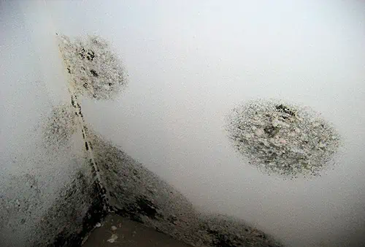
The leaching of sodium from the wall
I hypothesised in my study in 1993 that the black pin mould is reacting to the availability of magnesium and calcium in the paint and the gypsum that is evident on the walls, it is this that allows for the growth once low levels of moisture, break down the Calcium and magnesium and reduce the levels of sodium So4, which I considered to be a mould limiting factor.
Therefore, we remove the mould-limiting factor sodium So4 by leaching and replace it with high concentrations of calcium Ca when experiencing water saturation and ingress in the building.
Indeed, a study by STEINBERG, R.A (1946) et.al found that Magnesium, calcium, and strontium increase dry weight production in all the concentrations imposed on samples. All the fungi tested have their vegetative growth inhibited by sodium. The fungi tested had their vegetative growth inhibited by sodium, but the concentration causing inhibition can differ widely from species to species. Indicating that the sodium is the limiting factor, however, given the study by Hirvonen et al., 1997 and 2003 I question if the increase in mould growth is a response due to the myotoxicity increase in the Stachybotrys chartarum seen in the research Hirvonen, which is indeed the moulds defence mechanism that can stop eradication of the mould and allow for it to colonise even when biocides are used eliminate it.
Indeed, it was found STEINBERG, R.A 1946 et al, that even if salt solutions (sodium So4) were imposed on samples, growth was still obtained when high concentration of calcium Ca is delivered to the samples, which begs the question is the calcium being delivered to the samples reducing the mycotoxin response by the mould in reverse of what Hirvonen et.al, 2003 found in their research. The addition of Calcium Ca reduces the Myotoxic response, therefore if we increase Calcium Ca before application of biocides would eradication be effective by biocides.
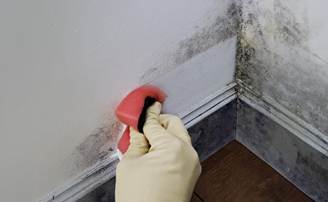
The Cleaning of a wall with biocides
This would indicate that sodium So4 in the gypsum plasterwork is a limiting factor for black pin mould growth and the main reason why black pin mould is not seen in areas of high efflorescence even when saturated. But colonisation is seen in areas of lower sodium So4 and higher calcium Ca. once the Calcium Ca reduces the mycotoxin effect seen in Hirvonen research 2003
In the research by T. Murtoniemi, M.M. Keina, A. Nevalainen and M.R. Hirvonen (Hirvonen et al., 1997), Department of Environmental Health, National Public Health Institute, Kuopio, Finland 1 2002/454: 2002, revised 2003
Where the growth of Stachybotrys chartarum was inhibited on plasterboard only if the same biocide, at the same dose, was added on the liner. If it was added into the core, then S. chartarum growth still occurred.
This would indicate that the core sample of gypsum plaster in the research were high in Calcium Ca and low in sodium. As in the latter case of the research 2003, the spores were also extremely toxic to mouse macrophages (unpublished data). This suggests that the susceptibility of different microorganisms against biocides may vary due to the myotoxicity.
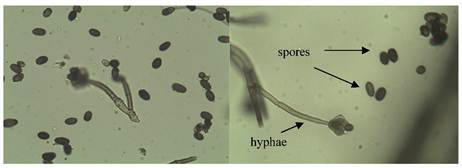
Testing of toxicity of Stachybotrys chartarum
Which begs the question, does the Stachybotrys chartarum increase cytotoxicity as a defence mechanism to the sodium and biocides, and indeed Is the myotoxicity a defence response by the mould that is preventing the eradication of the mould from dwellings worldwide even if the biocides are used. Conversely does the increase of calcium Ca reverse this process and reduce the myotoxicity. Also, by reducing the mycotoxin can we eradicate it.
I would hypothesise that the mycotoxin increase seen in the research by Hirvonen of circa 90%, is indeed a defence mechanism by the mould and the reason why biocides do not eradicate black pin mould from dwellings.
Indeed, if we look at Hirvonen 2003 et.al The Society for Applied Microbiology, Journal of Applied Microbiology, 94, 1059–1065 Starch in plasterboard sustains Streptomyces californicus growth and bioactivity of spores, When the starch was removed only from the liner (board 6) the biomass production and sporulation markedly decreased compared with reference board. When the starch was removed from the core as well as the liner (board 5), both growth and sporulation were almost totally inhibited.
Which begs the question is the starch and calcium combination the key to reduction in mould growth prevention in buildings.
One would hypothesise the increase of sodium So4 and the decrease in starch would produce conditions not conducive to mould growth in buildings.
Given this I am of the opinion that we need a new approach to eradication where the mould is prevented rather than controlled by biocides as by eradication by biocide the moulds just responded in an increase in mycotoxins by 90%, the reduction in starch in the gypsum and increase in Sodium So4 would produce gypsum that prevents mould growth rather than allowing for ideal conditions for its growth.
